
FOIA vs Court Records in Macomb County
The single most important rule for Macomb public records is this: Michigan FOIA does not apply to court records. The FOIA definition of public body excludes the courts. That means a request for a 16th Circuit Court case file, a Probate Court estate file, or a district court traffic file is not a FOIA request. Those files go through the clerk under Michigan Court Rule 8.119. A request for a Sheriff incident report, a county policy, or a county contract is a FOIA request because those are records of county public bodies.
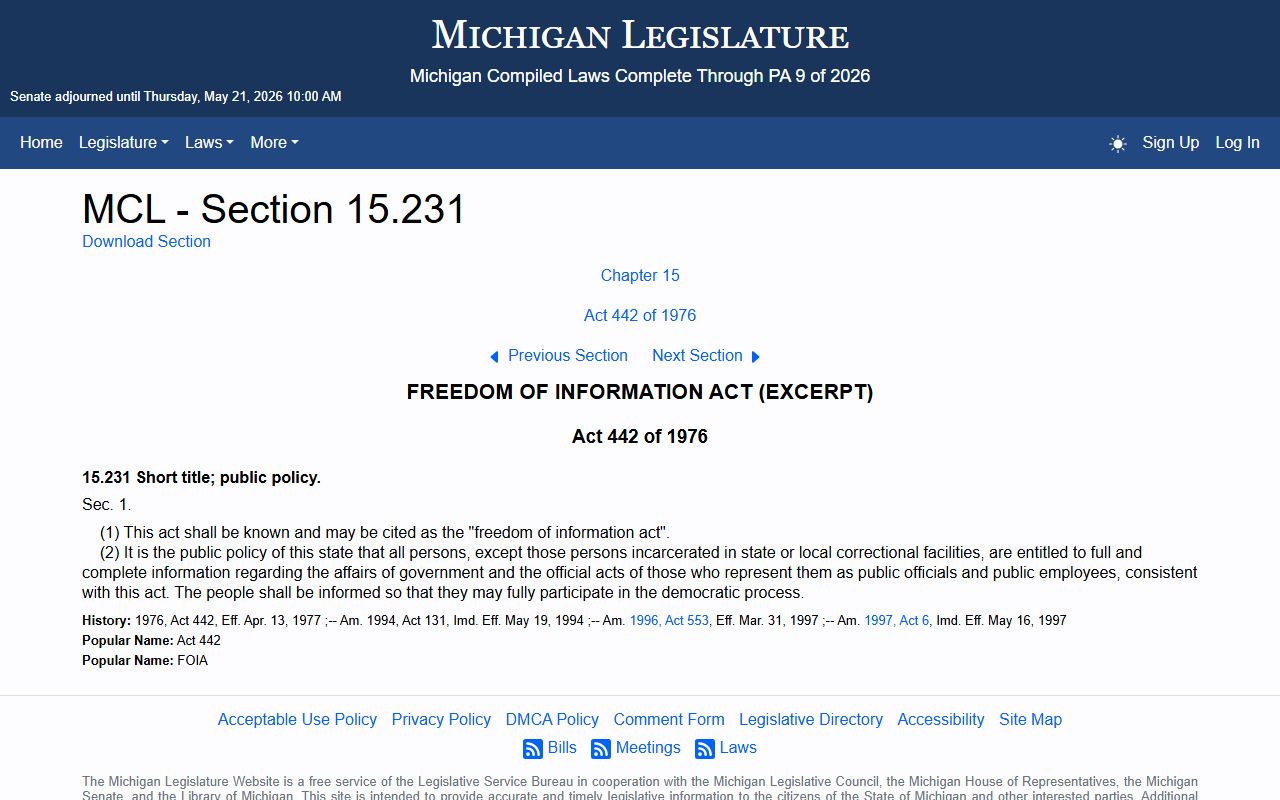
The Michigan FOIA statute opens with the policy goal of full and complete information about government affairs, with exceptions in the act. That policy frames every county FOIA request.
Macomb County FOIA Process
Macomb County's FOIA procedures and guidelines state that the county will respond within five business days after receiving a request. If all or part of a request is denied, the county issues a signed written denial. The denial identifies reasons and appeal rights. The county may extend the response time under the statutory rule, and may charge fees within the limits of Michigan FOIA.
- Identify the county department that holds the record (Sheriff, Prosecutor, Clerk's noncourt files, county administration).
- Write the request in clear language, describing the records sought.
- Send the request to the county FOIA coordinator or the named department.
- Wait the statutory response time (five business days, with possible extension).
- Pay any required fees or fee deposit.
- Receive the records, or a written denial with appeal rights.
Court Rule 8.119 for Macomb County Court Files
Michigan Court Rule 8.119 controls access to court records and the duties of clerks. The default is that case records are open unless a statute, court rule, or court order makes them confidential. Sealed records, juvenile files, adoption files, mental-health commitment files, and protected personal identifying information are nonpublic. The sealed status follows the file through transfers and appeals.
For Macomb cases, the clerk paths are: Macomb County Clerk for Circuit Court files; the Probate Register for probate; and the proper district court clerk for district files. The Michigan Courts site links the full court rules and SCAO forms.
Michigan FOIA Statutes
The Michigan FOIA is built from several core sections. Each one shapes how Macomb County answers a request.
Key statutes:
MCL 15.231 — FOIA short title and public policy.
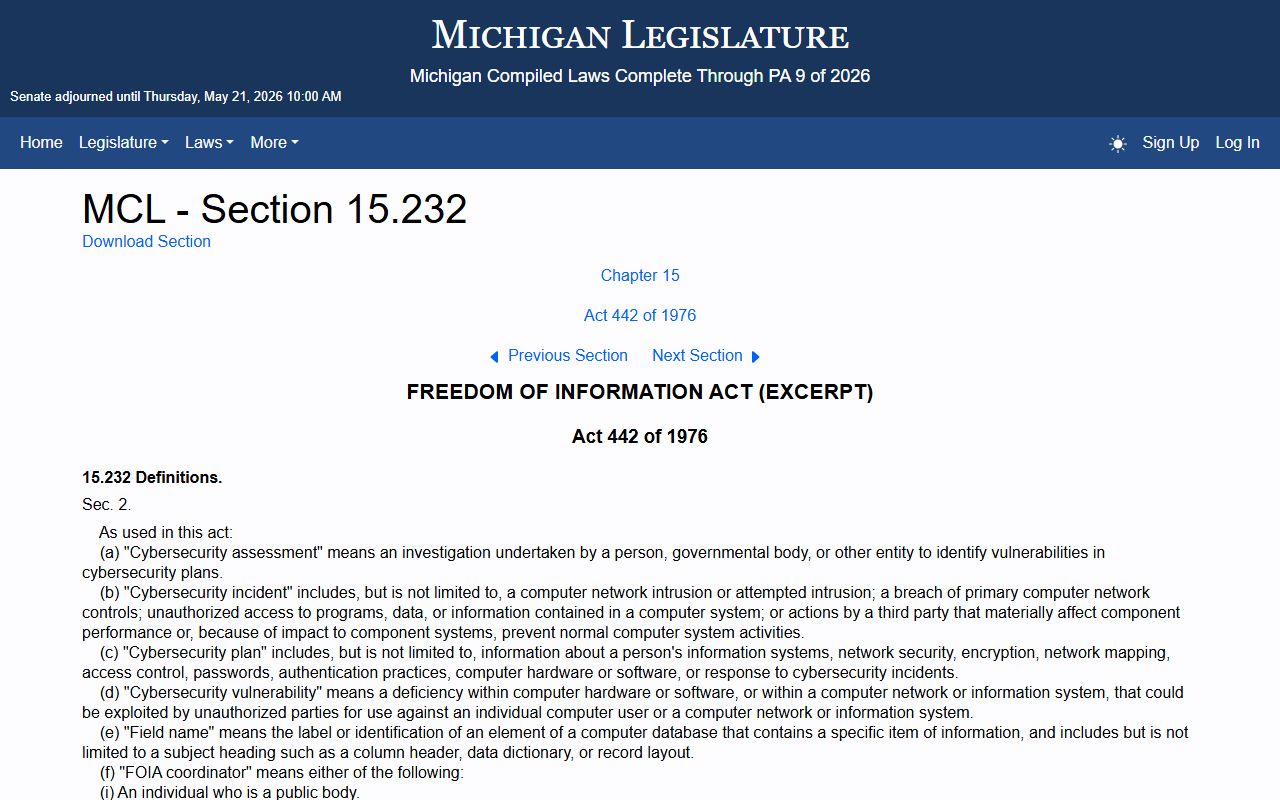
MCL 15.232 — Definitions, including public body and public record; courts are excluded from "public body."
MCL 15.233 — Right to inspect and copy public records.
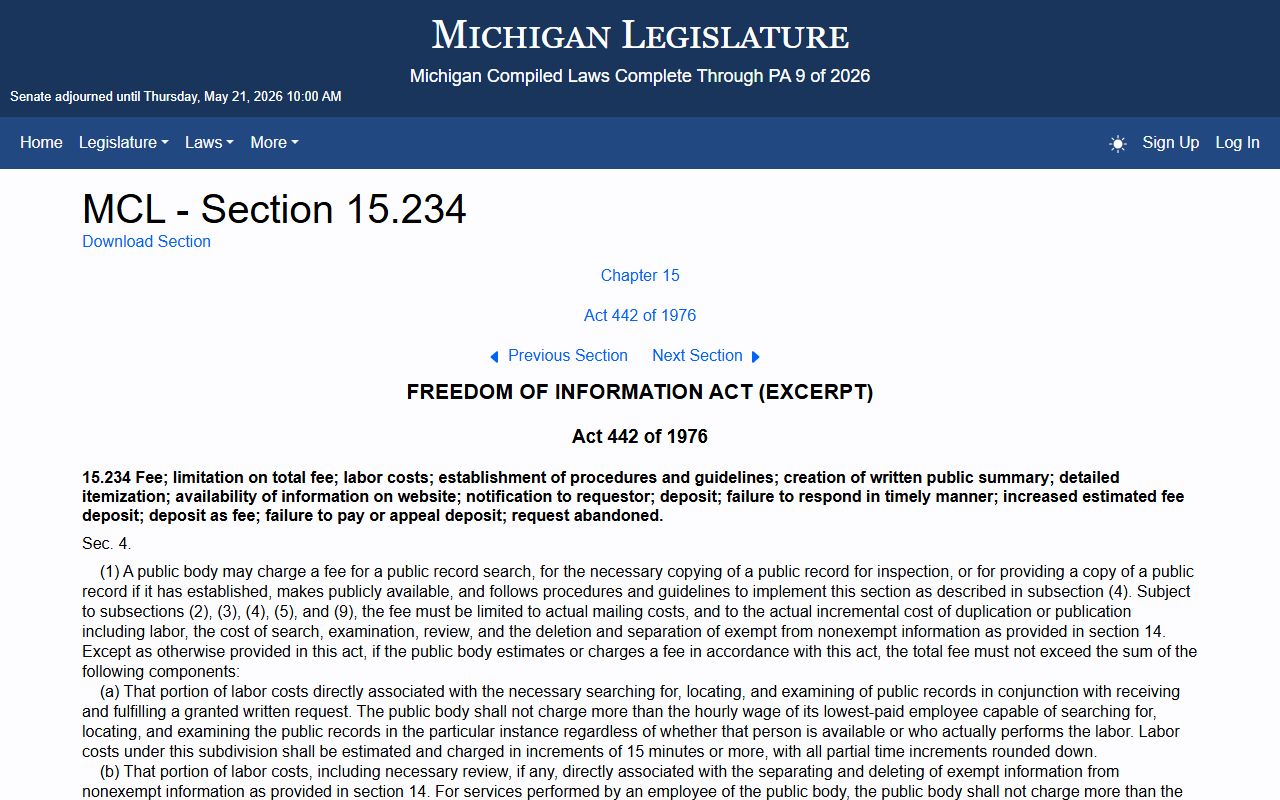
MCL 15.234 — Fees for search, review, separation, duplication, and mailing.
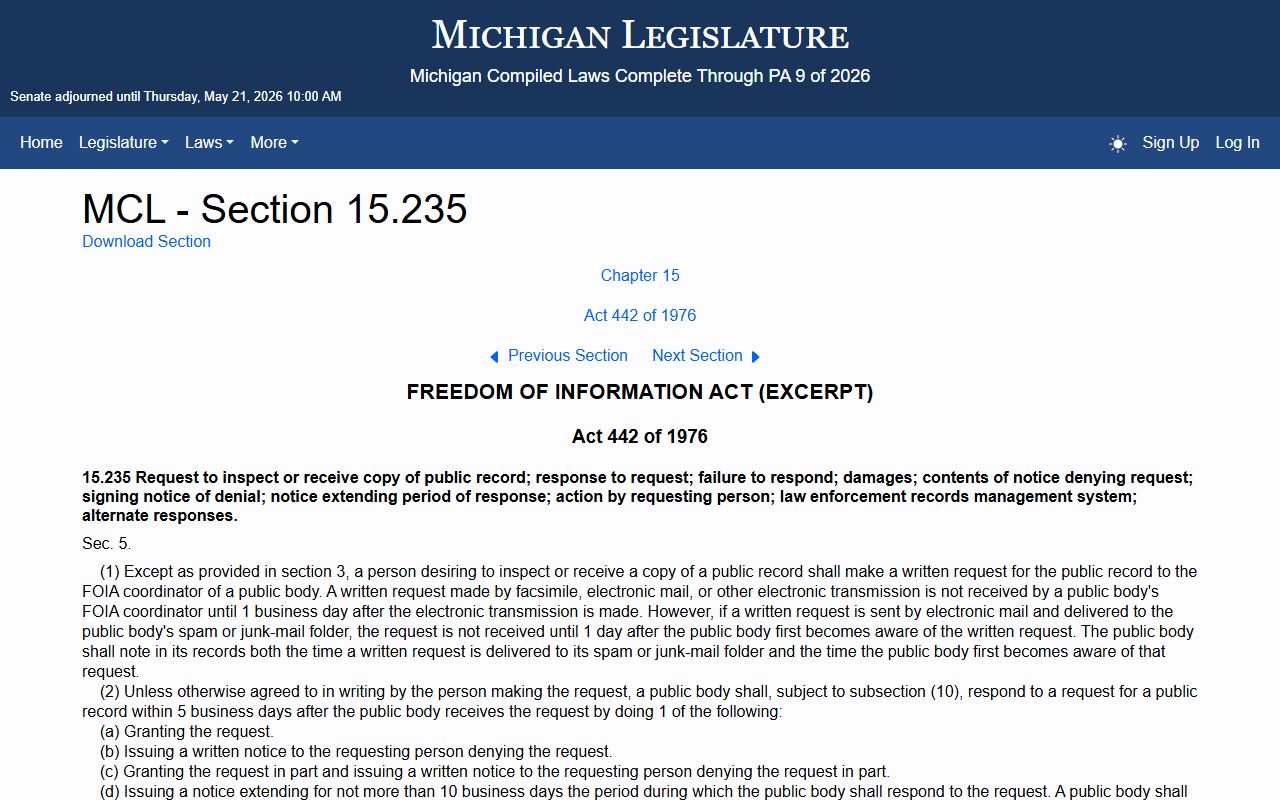
MCL 15.235 — Five business day response, with limited extension.
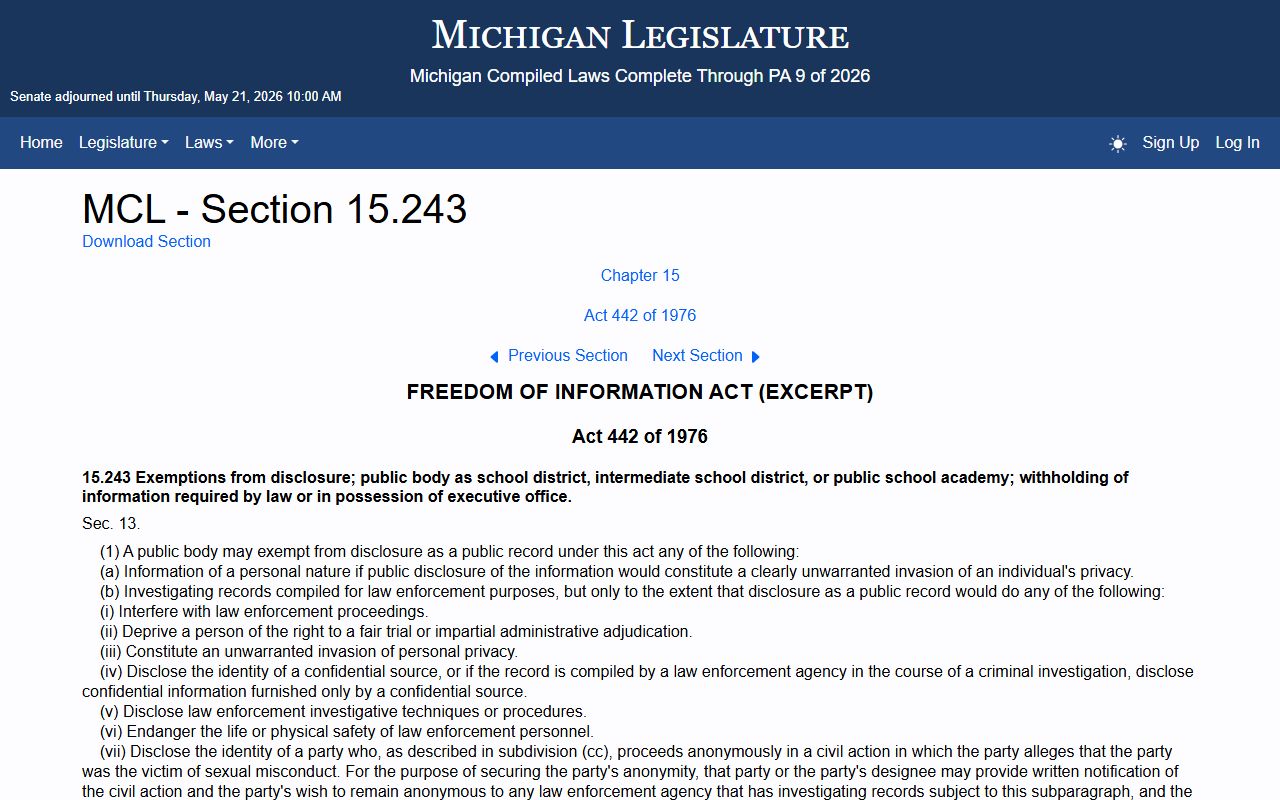
MCL 15.243 — Exemptions for privacy, law enforcement, security, trade secrets, and records restricted by other statutes.
Macomb County FOIA Fees
Fees follow MCL 15.234. The county may charge actual labor for search, review, separation of exempt material, duplication, publication, and mailing under detailed limits. Fee waivers or reductions are available in some cases under statutory rules. A fee deposit may be requested before the records are produced when the estimated fee exceeds the statutory threshold. The Register of Deeds runs its own fee schedule for recording and copies.
| Fee Type | Notes |
|---|---|
| Labor (search, review, separation) | Actual labor cost up to MCL 15.234 limits. |
| Duplication | Per-page copy cost. |
| Mailing | Actual postage. |
| Deposit | Allowed when the estimated fee exceeds the statutory threshold. |
| Indigent waiver | Available in qualifying cases under statute. |
Register of Deeds Records
The Macomb County Register of Deeds at 120 N. Main Street records real-property documents, including deeds, mortgages, lis pendens, liens, and federal tax liens. Recording costs $30 per document under the Register's FAQ, effective October 1, 2016, regardless of page count. Owner or lien searches can be done in person, by mail with a $5 search fee per name or address, or online. The Register's online land record search is grantor/grantee-based. Real-property records are not court files and are not in CourtView.
Vital Records: Marriage, Birth, Death
Vital records sit with the County Clerk / Register of Deeds office at 120 N. Main Street. Marriage licenses and certified copies, birth certificates, and death certificates are issued from this office. Some vital records are restricted to qualified persons under Michigan law. For very old vital records, the Michigan Department of Health and Human Services holds historic state records. Marriage license details are on the marriage and divorce records page.
Sheriff Records and Police Reports
Sheriff incident reports, jail records, body-camera footage, and other Sheriff's Office records follow Michigan FOIA. The Sheriff's Office page links a "Purchase police report online" service for routine report orders. Active investigation material, informant identities, and certain security-sensitive details may be exempt under MCL 15.243. Jail policies and administrative files are FOIA records, while jail booking events on the public JailTracker roster are released through the inmate locator process.
FOIA vs MCR 8.119 at a Glance
Two different rule sets govern public access in Macomb County. FOIA covers county and local public bodies. MCR 8.119 covers court records. Knowing which rule applies saves time and dollars on the wrong process.
| FOIA | MCR 8.119 | |
|---|---|---|
| Applies to | County departments, Sheriff, Prosecutor (admin) | 16th Circuit, Probate, district courts |
| Response time | 5 business days, with extension | Set by the court and clerk procedures |
| Fees | MCL 15.234 limits | Set by clerk for each court |
| Appeal | Admin appeal or circuit court | Court administration or motion in the case |
FOIA Appeals and Circuit Court
If a Macomb County FOIA denial cannot be resolved by administrative appeal, the requester can file in the 16th Judicial Circuit Court. The lawsuit is a "judicial review" of the denial. The circuit court can order disclosure, sanction the public body, and award fees in qualifying cases. Most requesters never need to file in court because clear, narrow requests usually get a workable response. Knowing the appeal exists, however, keeps the public body honest about denials and exemptions. Court records denials follow a different path under MCR 8.119, not FOIA.
Other County Departments and FOIA
FOIA at Macomb County covers many departments beyond the Sheriff and the courts. The Health and Community Services department, the Public Defender, the Prosecutor's Office (administrative records only), Roads, Planning and Economic Development, Senior Services, and the Election Department all keep records that may be FOIA-eligible. The Election Department on Market Street handles voter rolls and polling place data with statutory protections that limit redistribution. Building permits, animal control, and parks records also sit with county or local public bodies and follow the same statutory framework.
Macomb County Prosecutor and Public Defender Records
The Macomb County Prosecutor's Office publishes press releases and victim-services information through its official news page. Working files of the Prosecutor — investigation notes, charging memos, attorney work product — are generally exempt from FOIA under MCL 15.243. The Macomb County Office of Public Defender page publishes mission and FAQ information. Attorney-client materials of the Public Defender are privileged and not subject to FOIA. Case-level court records remain available through CourtView and the relevant clerk.
Tips for Filing a Macomb County FOIA Request
A clear, specific request gets a faster, cheaper response. Identify the time period, the type of record, and the office that holds it. Avoid asking for "all records about X" without a date range; the broader the request, the higher the fee. Include contact information so the county can reach you with fee estimates or clarifying questions.
- State the records sought with dates and descriptions.
- Name the department (Sheriff, Prosecutor, county administration, etc.).
- Ask whether redacted electronic copies are available; electronic copies usually cost less.
- Note any fee waiver request for indigent requesters under the statute.
- Confirm the response method: email, mail, or in-person pickup.
Denials and Appeals
A FOIA denial in Macomb County must be in writing and signed. It must identify the reasons and the appeal options. Under Michigan FOIA, an appeal can go to the head of the public body (if a process exists) or to circuit court. The denial process is different for court records. A court access denial typically routes through the court's administration or by motion in the underlying case under MCR 8.119.
Recent Macomb FOIA Example
On June 27, 2024, the Michigan Attorney General announced a Macomb County judge had dismissed FOIA claims against 16 cities and townships involving election records with sensitive electronic pollbook data. The AG summary said the requested records contained public information but also sensitive voter data and proprietary information that local officials could not readily remove or redact. The case illustrates how Michigan FOIA can require disclosure of public records while still protecting sensitive data through exemptions and redaction.